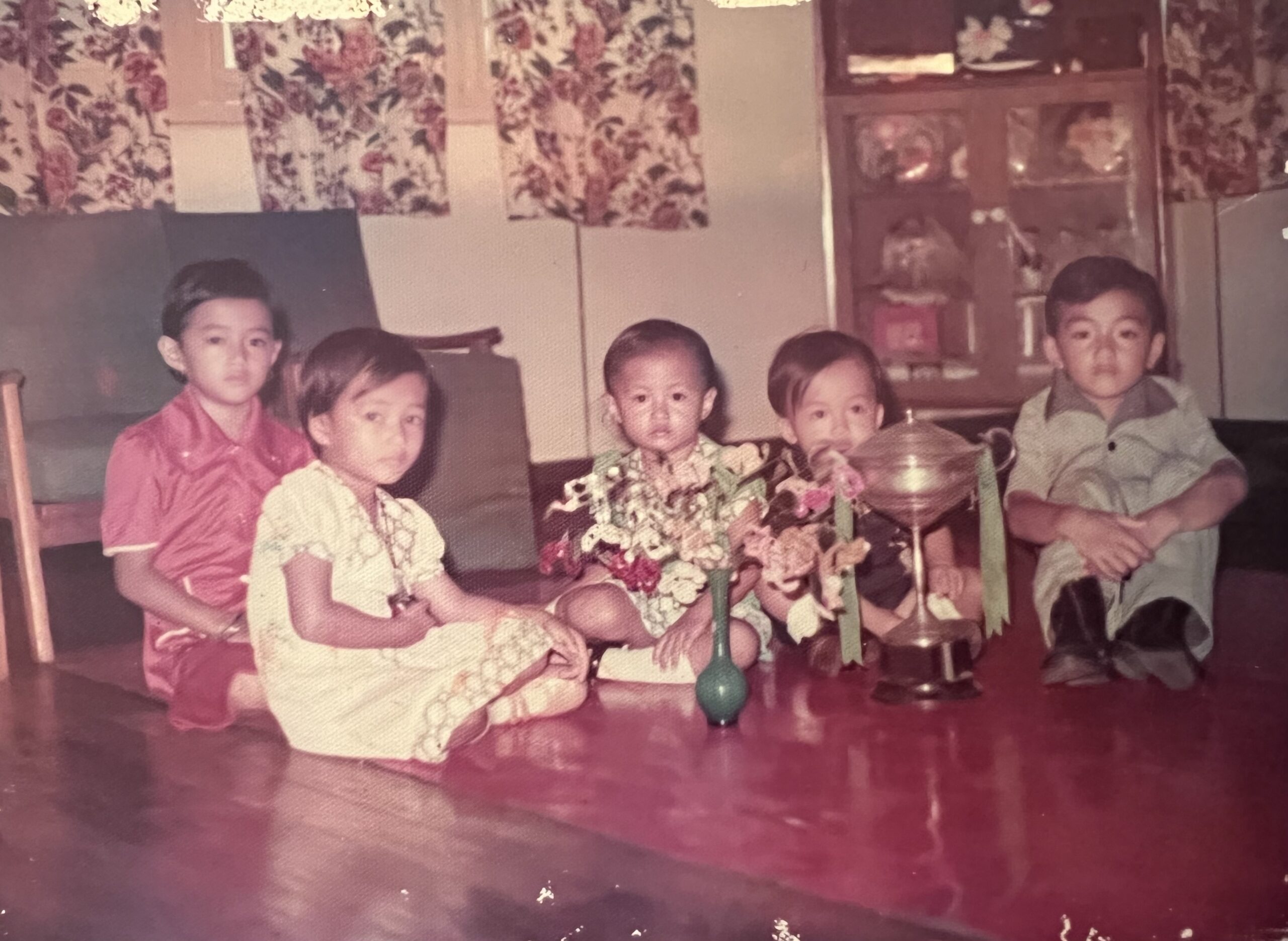
Childhood
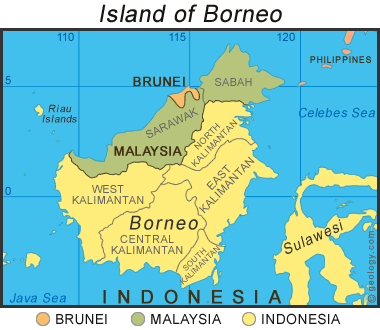
We’re in Sabah…
… a northern sliver of Borneo that belongs to Malaysia instead of Indonesia, where children take the first names of their fathers as their last names.
It is where my Nenek (grandpa) Dannyseus was renamed by his daughter.
My dad sits behind the wheel of my uncle’s van.
He drives us through Papar and my mother’s memory.
As she looks out the window, she feels —— for perhaps
the first time in my life —— the need
to tell stories from the childhood she sees there.
In the car, she talks about Nenek Pondo.
I learn that her childhood wasn’t all junk yard diving and drunken beatings like she made it sound sometimes. She talks about how Nenek —— who I always knew was a conman — was once a very good conman, and they’d had money before he gambled it all away. Then they had to fire their chauffeur and move out of a white brick house into a bamboo one, somewhere in Sabah.
She says it proudly and finally; that living in Sabah can either make or break you —— and it broke them, my siblings. It broke them. But look at me.
I looked at her, and thought of wine glasses in flight.
I only ever knew him as Nenek Pondo.
I sometimes thought it was weird he had so many names, but I didn’t question it; I figured maybe he liked to collect them. It wasn’t until I was ten that I found out “Pondo” was the kind of name you use when he isn’t around.
It’s from the Dusun pondogonon, which my mother has translated on different occasions as both “big fat ghost” and “big monster ghost.”
The nickname was as affectionate as the user needed it to be.
I can hear something in it though. It’s something I see in my mother; something she’s given to me. Listen: pondogonon. Its elasticity. There is a back-and-forth. You start at the lips, back onto the tongue, but just before it escapes, you’re pulled back in —— the “go” traps you, and you’re left to echo in the chamber: “onon.” Forever on.
It has the feel of something vacillating, something trying to flee, perhaps from the ghost of him, who I hear in her every laugh and in my own mumble, and is clearest when she screams.
Nenek Juvita is most apparent in our silences.
I’ve heard growing up is just the process of becoming your parents. I’m beginning to realize just how complete that becoming is.
I listen to my mother describe Nenek Pondo and Nenek Juvita, and suddenly her every contradiction seems to cohere. Hypocrisy becomes logic. How else could she sit before my camera with that deficit of attention that seems so focused? It is the same answer to another question I’ve asked: how can one woman be at once so stubborn but so flighty? Now I know.
She has a father who fought, and a mother who took flight.
